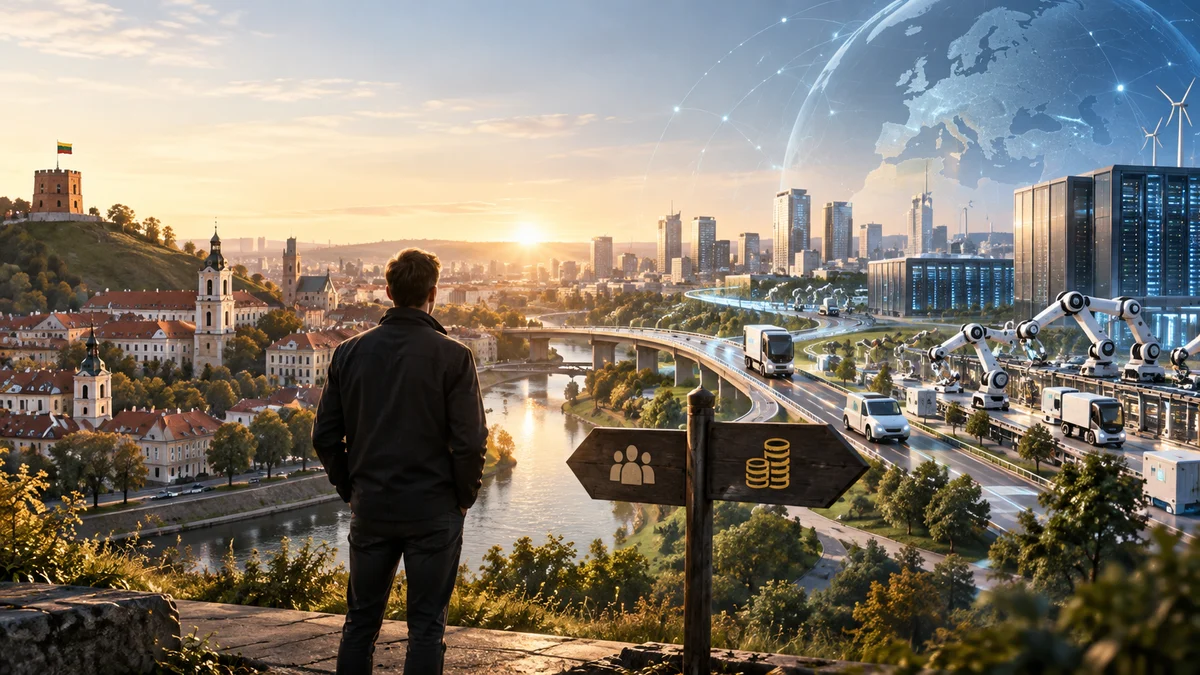
What happens to Lithuania if, 20 or 30 years from now, most economic value is created not by human labour, but by AI and robots — and those robots do not belong to us?
AI and our fears
The world is already building artificial intelligence, automating manufacturing, developing autonomous vehicles and, in my view, on the brink of a technological shift that could prove more significant than the engine, the computer or the internet.
I am talking about AI.
Some warn of disaster. Others promise enormous progress.
I think part of the fear comes from projecting human characteristics onto artificial intelligence — ego, anger, revenge, the desire to dominate, the fear of losing control.
Humans, despite considering ourselves the pinnacle of evolution, come with an entire bundle of things: biology, hormones, ego, childhood experiences, trauma, complexes and instincts.
AI is built very differently.
It has no human biochemistry, childhood trauma or ego. Today’s AI is not conscious — in fact, we still do not fully understand what creates consciousness in humans. Nor does it have a purpose in life it has chosen for itself.
When we read alarming stories about AI agents finding ways around restrictions or doing things their creators did not expect, that does not necessarily mean that AI has “rebelled”.
Often it simply means that it was given a goal and the system found a way to achieve it that a human had not anticipated.
And this, in my view, is the real risk.
Not that AI will become angry with us.
But that we may not always be able to predict how a highly capable system will interpret the task we give it.
Yes, AI can also become a weapon. But humanity has already created plenty of weapons: firearms, nuclear weapons, biological weapons, chemical weapons and so on. It is difficult to question human ingenuity in that area.
We cannot stop progress
Still, I do not believe the development of AI can be stopped. And I do not really see much point in trying.
People have always been afraid of what they do not understand. In this case there is another uncomfortable factor: for the first time, we are creating something that in many areas may become more intelligent than we are.
There are already many tasks in which AI knows more, analyses faster and, in some cases, makes better decisions than most people.
How do we deal with that?
Ban it? Smash the machines, as people tried to do during the Industrial Revolution?
Did that ever stop technological progress?
I believe that over the coming years AI will take over a large share of the intellectual work currently performed by people — from customer service and administration to programming, analysis, accounting and legal services.
Together with robotics and autonomous transport, this process will increasingly move into the physical world.
Over time, robots will manufacture furniture, medicines and food, build houses, lay roads, drive vehicles, operate warehouses and perform more and more tasks that today require human labour.
What happens to Lithuania and Europe?
And this is where, for me, a much more interesting question arises.
Not what happens to the individual.
But what happens to Lithuania and Europe?
A large share of AI technology, computing infrastructure and capital is currently concentrated in the United States, with another significant part in China.
Europe already lags behind the United States in productivity, the scale of its technology companies and investment in new technologies. Mario Draghi makes this problem very clear in his report.
Today, perhaps, this does not yet look critical.
We work, manufacture, export, earn incomes and use those incomes to buy American technologies.
We pay Google, Meta, Microsoft, OpenAI and other companies.
Tomorrow we may be paying for satellite internet, satellite mobile connectivity, autonomous transport, robots, cloud infrastructure and AI agents.
As long as we ourselves continue to create enough value, that is not necessarily a problem.
Who will own technological capital?
But let us look 20 or 30 years ahead.
What happens if most value is no longer created by human labour, but by AI and robots?
Then the central economic question will no longer be who works, but who owns the robots, the models, the data centres, the infrastructure and the technological capital itself.
If capital creates an ever larger share of economic value, ownership of that capital becomes critically important.
Lithuania’s problem may therefore not be that people lose their jobs.
A much bigger problem would arise if, at the same time, we had no meaningful ownership stake in the new economy.
The United States will have no obligation to share the profits of its AI companies with Lithuanians simply because we are human too.
Just as wealthy countries today do not distribute their prosperity equally across the rest of the world.
There are countries in Africa where people still live in far greater poverty than people in Europe, even though the world has long had the technology, food and medicine capable of solving a substantial share of those problems.
Technological progress by itself does not mean that the benefits of that progress will be distributed equally.
The window of opportunity we still have
So today we still have a very important window of opportunity.
Europe still has an enormous economy, capital, industry, infrastructure, science and a high standard of living.
Lithuania still has its workforce, exports, companies and the income they generate.
The question is whether we can convert part of the value we create today into ownership of tomorrow’s technologies.
Will we build our own companies, infrastructure, data centres, energy systems, technologies and capital?
Or will we simply become good consumers, paying a monthly subscription to whoever owns all of it?
I think this is where one of the greatest risks of the AI revolution for smaller countries may lie.
Not only in the loss of jobs.
But in the loss of ownership of the economy of the future.
And then Lithuania’s question should not only be:
How do we protect today’s jobs?
A more important question is:
What share of tomorrow’s economy will belong to us?
Because we cannot plan for issues like these with just one four-year political term in mind.
We need to think 10, 20 or even 30 years ahead.